Pi Patel–God relationship
Life of PiPi Patel’s relationship with God is formed through ritual, widened by encounters with other faiths, and tested at sea, where belief becomes a practice he must repeatedly renew. It does not remove danger or suffering. Instead, prayer, religious observance, and attention to the surrounding universe give him ways to endure them without surrendering his wish to live.
Early religious formation
Pi’s first experience of a temple comes in infancy, when he is taken to one in Madurai as part of a Hindu rite of passage. He has no conscious memory of the visit, but later understands his religious attachment as having begun there: with the practices, objects, and forms of worship that made a temple feel like home before he could explain their meaning. His account joins devotion to both the senses and belief, presenting them not as competing sources of religion but as parts of one formative experience.
That early Hindu framework also gives Pi a way to think about the relationship between God and human understanding. He describes Brahman as both beyond qualities and description, and approachable through forms with recognizable attributes. The first is beyond the reach of ordinary language; the second permits a relationship shaped by qualities such as love and mercy. This distinction makes room in Pi’s religious life for both mystery and personal devotion. His faith is not simply adherence to a ritual inherited in childhood: it includes an account of how the divine can be at once beyond comprehension and intimately addressed.
Learning devotion through Islam
Pi’s relationship with God is broadened by watching a Muslim baker pray. The call to prayer interrupts their conversation, and the baker lays out a carpet in the bakery and performs his prayers there before returning to the discussion as if the interruption were an ordinary part of the day. Pi initially interprets the repeated movements as a kind of exercise. Later, while praying in church, he finds the memory of this physical communion with God returning to him. The encounter unsettles any simple division between unfamiliar religious practice and genuine devotion.
On a subsequent visit, Pi asks the baker what his religion is about. The answer centers on the Beloved. Pi is moved by the devotion and brotherhood he associates with Islam, and when worshippers arrange themselves shoulder to shoulder in rows at the mosque, he experiences bringing his forehead to the ground as a deeply religious contact. He later learns that the baker is a Sufi mystic who seeks union with God and understands that relationship as personal and loving. The baker’s teaching presents divine approach as reciprocal: a person turns toward God, and God responds with greater closeness. Pi’s religious world thus expands through particular acts of prayer and companionship, rather than through abstract comparison alone.
The crisis of resolve at sea
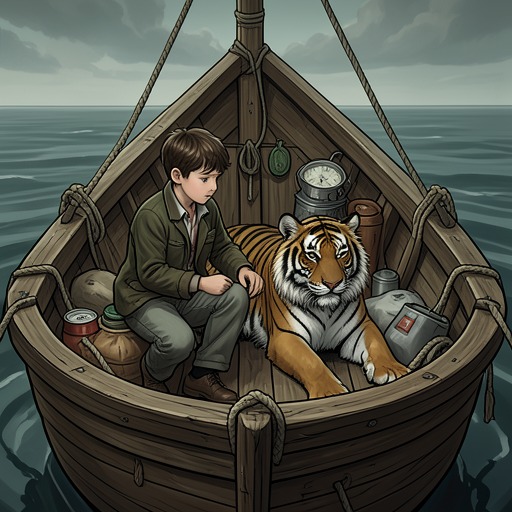
At sea, the relationship becomes a matter of immediate endurance. After food, water, and rest briefly restore his strength, Pi confronts the danger of remaining aboard the lifeboat with Richard Parker. Leaving it would also mean near-certain death in the open ocean, so neither choice offers safety. Faced with the likelihood of dying and the time to imagine everything he stands to lose, he thinks of his family and former life and begins to give up.
The turning point is an inward refusal to accept that ending. Pi resolves that he will keep working to survive and connects that resolve directly to God’s presence with him. The belief does not make Richard Parker less dangerous: the tiger growls as Pi becomes determined to act. But Pi shifts from imagining death to organizing his survival. He looks for shelter and constructs a raft from oars, life jackets, and a lifebuoy. In the scene, faith is linked to action: it helps him commit to continued effort, while the practical work of staying alive remains his responsibility.
Rituals adapted to the lifeboat
Pi continues religious practice without the settings and materials ordinarily associated with it. He conducts solitary Masses without a priest or consecrated hosts, observes darshans without murtis, and performs pujas using turtle meat as prasad. He also tries to offer devotion to Allah, though he does not know where Mecca is and gets the Arabic wrong. These improvised forms do not erase the differences among the traditions he practices. They show instead how he carries several devotional habits into circumstances that cannot accommodate their usual forms.
The rituals bring him comfort, but not steadily or effortlessly. Pi acknowledges anger, desolation, and exhaustion, and describes moments when loving God feels difficult. When those states threaten to overwhelm him, he names the objects and conditions around him as belonging to God: his improvised clothing, Richard Parker, the lifeboat, the open expanse of water, and the sky. Repeating these declarations places even the threatening parts of his situation within a religious frame. Yet the same objects resist any easy consolation: his clothing comes apart, Richard Parker remains dangerous, and the lifeboat feels confining. Pi’s practice therefore includes both affirmation and an unsparing recognition of what makes faith hard.
Cosmic perspective, despair, and renewal
One night Pi looks out from beneath the canopy at the moon, stars, and apparently limitless sea. He compares the experience to the sage Markandeya beholding the universe within Vishnu, and for a time he sees his suffering as finite and small within a larger setting. He accepts that perspective and returns to sleep after murmuring Muslim prayers. Daylight brings a countervailing insistence: his suffering matters to him because he wants to live. The account holds these responses together rather than resolving one into the other. A sense of cosmic scale can quiet his protest, but it cannot cancel his attachment to his own life.
The absence of scripture aboard the lifeboat also shapes this relationship. Pi longs for a book with a story he could return to, but has only the survival manual, which he reads repeatedly, and a diary in which he records practical events and feelings. Later, when he finds a Bible in a hotel room in Canada, he bursts into tears. The next day he contributes to Gideons International and urges the organization to distribute sacred writings beyond hotel rooms and to include texts from other faiths. The gesture extends Pi’s own experience of religion: scripture matters as a quiet source of companionship, and its reach should not be confined to one tradition.
During the ordeal, despair repeatedly returns, but Pi says it passes. A school of fish, a task that needs doing, or the thought that his family has been spared the suffering can interrupt it; afterward, God remains a point of light in his heart, and Pi continues loving. His relationship with God is therefore neither a guarantee of rescue nor a simple escape from doubt. It is sustained through repeated practice and renewed attention, giving shape to endurance while leaving fear, grief, and the desire to live fully present.